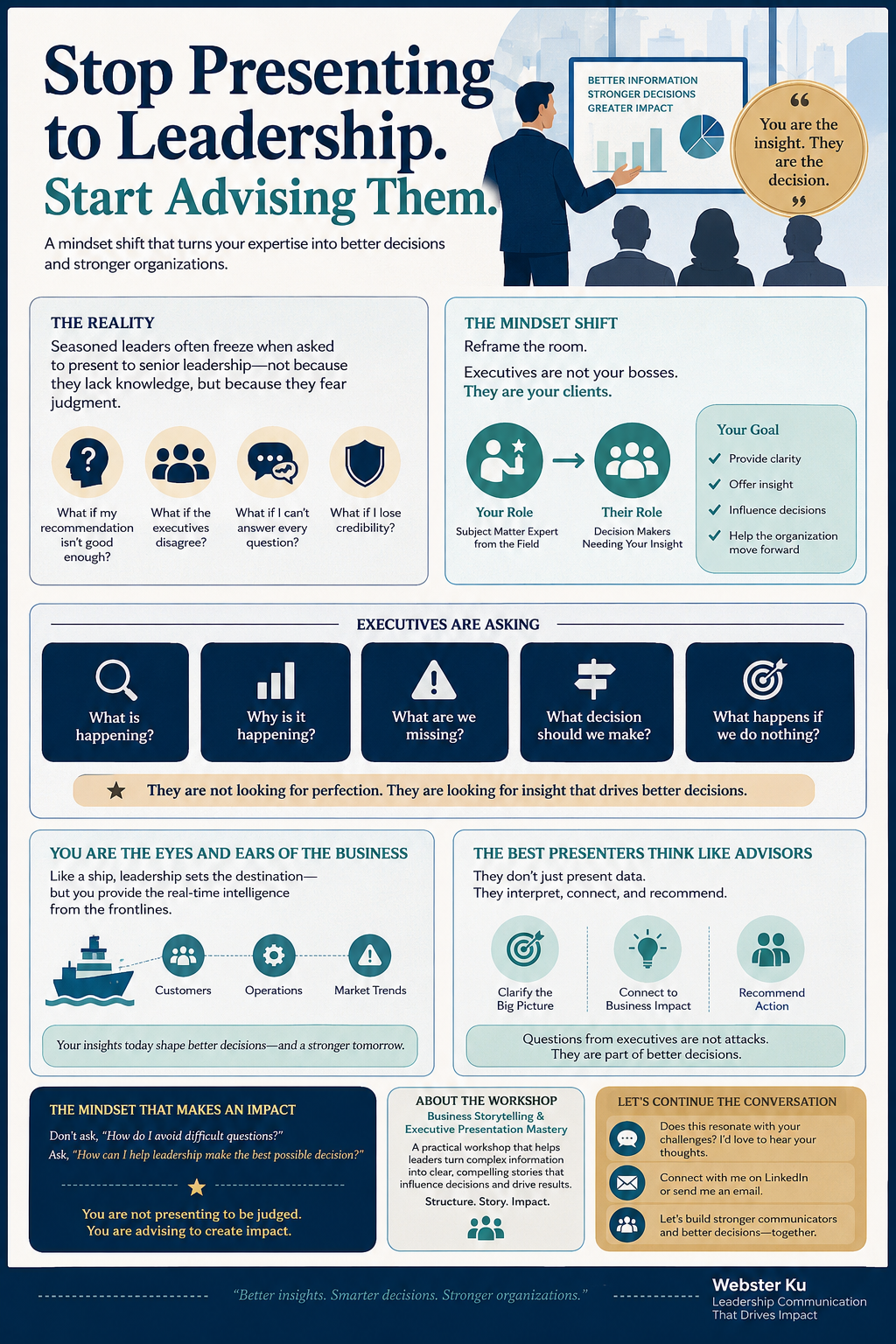
Why experienced leaders freeze in front of executives and the mindset shift that transforms executive presentations.

The Paradox I See in Almost Every Leadership Workshop
One of the most rewarding programs I facilitate is Business Storytelling & Executive Presentation Mastery.
The participants are rarely new managers.
Most have spent years leading teams, solving operational challenges, and consistently delivering results. They know their business. They know their customers. They understand their operations better than most people in the organization.
Yet when they're told,
"You'll be presenting your findings to senior leadership."
Everything changes.
Their confidence drops.
They begin questioning every slide.
They rehearse every sentence.
Not because they haven't done the work.
Not because they aren't capable.
But because standing in front of senior leadership feels different.
Over the years, I've realized that the biggest obstacle isn't presentation skills.
It's perspective.
The Real Challenge Isn't Public Speaking
Many people assume presentation anxiety comes from speaking in front of an audience.
That may be true for some.
But experienced leaders often face something deeper.
They're afraid of being evaluated.
Questions begin to surface:
What if my recommendation isn't good enough?
What if the executives disagree?
What if I can't answer every question?
What if I lose credibility?
Ironically, these are often the very people leadership depends on the most.
They spend every day with customers.
They lead frontline teams.
They understand operational realities.
Yet they walk into the room believing they are there to defend their work.
That mindset creates unnecessary pressure.
A Reframe That Changes Everything
During the workshop, I invite participants to look at executive presentations differently.
I ask them one simple question.
What if your executives weren't your bosses?
What if they were your clients?
The room usually goes quiet.
Because that single shift changes everything.
Your responsibility is no longer to impress leadership.
Your responsibility is to help them make better decisions.
Senior executives cannot be everywhere.
They don't experience every customer conversation.
They don't witness every operational challenge.
They don't see every trend developing in the field.
That is why they rely on leaders across the organization.
They need your expertise.
Not your perfection.
Executive Presentations Are Decision-Making Conversations
Once leaders adopt this mindset, another realization follows.
Executive presentations are not performance reviews.
They're decision-making conversations.
Leadership isn't asking,
"Can this presenter speak confidently?"
They're asking,
What is happening?
Why is it happening?
What are we missing?
What decision should we make?
What will happen if we don't act?
The quality of these answers matters far more than the quality of the animations in your slides.
The purpose of executive communication is to reduce uncertainty.
Your job is to provide clarity.
Your Experience Is Strategic Intelligence
Imagine an organization as a ship.
The executive team determines the destination.
But they rely on information from every part of the vessel to steer it safely.
Frontline leaders are often the first to notice changing customer expectations, operational bottlenecks, market shifts, and emerging risks.
Those observations become strategic intelligence.
When leaders stay silent because they fear challenging senior management, valuable insight never reaches the people making decisions.
Silence doesn't simply protect the presenter.
It deprives the organization of better decisions.
The Best Presenters Think Like Advisors
The leaders who consistently influence executives are rarely the most charismatic speakers.
They're the ones who think like advisors.
They don't present information.
They interpret it.
They connect operational realities with business impact.
They recommend actions.
Most importantly, they understand that questions from executives are not attacks.
They're signs that leadership is thinking through the decision.
That changes the emotional dynamic of the entire conversation.
Final Thought
The next time you're invited to present to senior leadership, don't ask yourself,
"How do I avoid difficult questions?"
Ask yourself,
"How can I help leadership make a better decision?"
Because you're not standing in front of the people who judge your work.
You're standing beside the people who depend on your expertise.
And that's a very different conversation.
About the Workshop
This mindset is one of the many concepts explored in my Business Storytelling & Executive Presentation Mastery workshop.
The program helps managers and leaders transform complex operational updates into clear, strategic stories that enable better business decisions. Participants learn how to structure executive presentations, communicate with confidence, influence stakeholders, and present recommendations that resonate with senior leadership.
Whether presenting quarterly business reviews, project updates, business cases, or strategic initiatives, the goal remains the same:
Help leaders become trusted advisors—not just better presenters.
Does this resonate with the challenges your leaders face?
I'd love to hear your thoughts. Connect with me on LinkedIn or send me an email. I'm always happy to exchange ideas on leadership communication, business storytelling, and developing confident presenters.