Why organizations don’t lose talent—they lose the ability to listen.
Executive Insight
“An organization’s greatest competitive advantage is not having fewer problems. It is creating an environment where people feel safe identifying problems before they become expensive.”
Every Company Wants High Performers…
Every leadership team says they want employees who:
✓ Think critically
✓ Take ownership
✓ Challenge assumptions
✓ Identify risks early
✓ Improve how work gets done
Yet somewhere between recruitment and promotion, something changes.
The employee who once impressed everyone with initiative gradually becomes known as…
“Too opinionated.”
“Too direct.”
“Always finding problems.”
“Not a team player.”
The uncomfortable truth is this:
Many organizations unintentionally punish the very behaviours they claim to value.
The High Performer Paradox
One of the defining characteristics of high performers is that they don’t merely complete tasks.
They improve systems.
They notice patterns others overlook.
They identify risks before they become crises.
They ask difficult questions because they care about outcomes—not because they enjoy disagreement.
Unfortunately, when organizational culture lacks psychological safety, these behaviours become misinterpreted.
Instead of seeing commitment…
leaders see criticism.
Instead of seeing ownership…
they see resistance.
Instead of seeing strategic thinking…
they see negativity.
Leadership Reflection
“If your highest performers have stopped raising concerns, ask yourself whether they’ve become more satisfied—or simply more silent.”
The Cost of Silence
Most organizations measure productivity.
Some measure engagement.
Very few measure employee voice.
Yet employee voice is often the earliest indicator of organizational health.
When employees repeatedly experience that speaking up produces little change, they usually follow a predictable path.
The resignation letter is rarely the beginning of the story.
It is usually the final chapter.
Why Good Intentions Fail
Organizations often assume the problem lies with the employee.
Sometimes it does.
However, in many cases, the real issue is that neither side has developed the skills required to navigate constructive disagreement.
High performers need to communicate in ways that build influence.
Leaders need to receive difficult messages without becoming defensive.
This is where three leadership capabilities become essential.
The Leadership Triangle
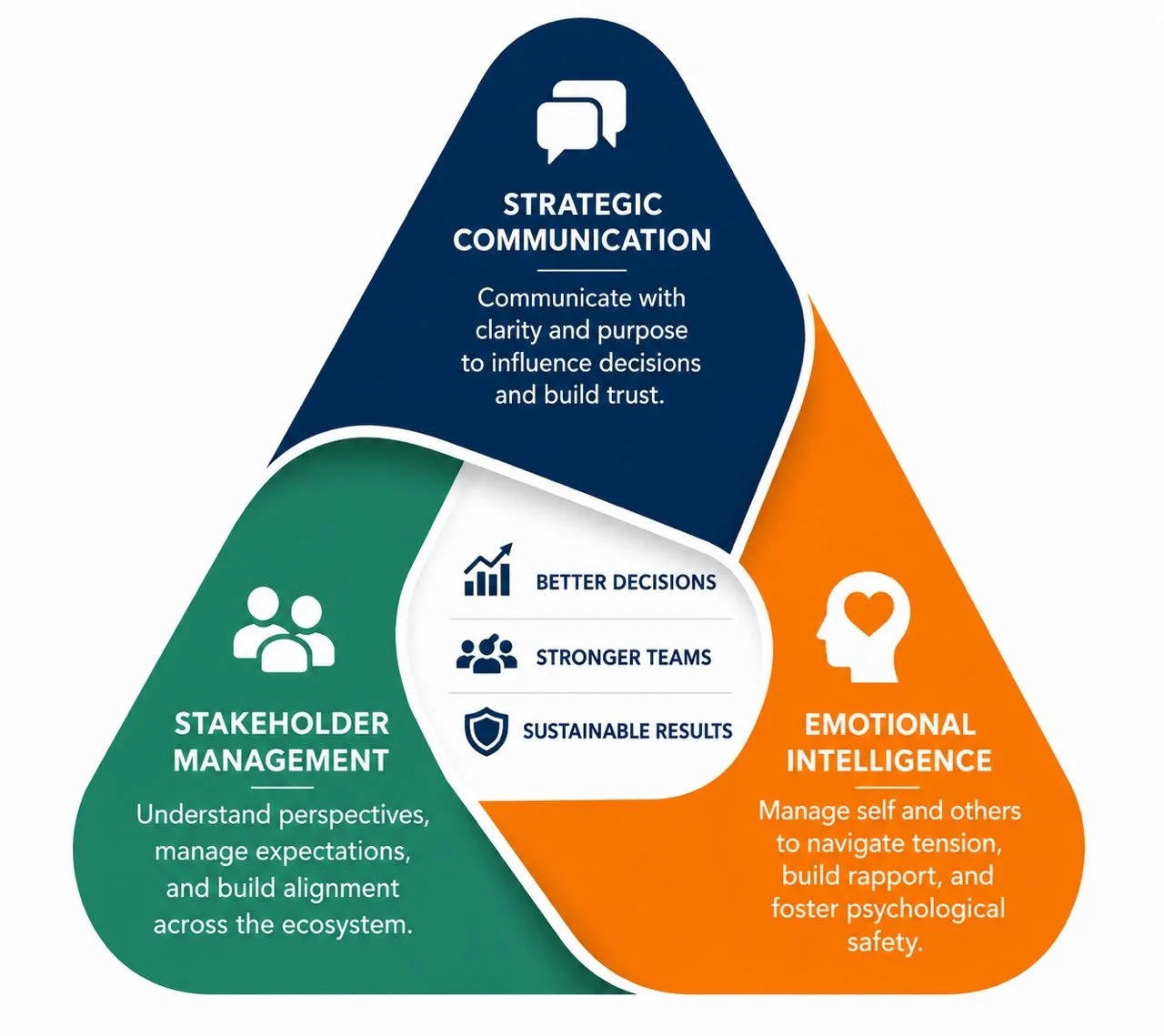
Together they create:
• Trust
• Influence
• Psychological Safety
• Faster Decision Making
• Higher Performance
These capabilities are mutually reinforcing.
Weakness in any one area reduces the effectiveness of the other two.
1. Strategic Communication
Speaking up is easy.
Being heard is difficult.
Strategic Communication helps professionals move conversations from confrontation to collaboration.
Instead of saying
“This won’t work.”
they learn to say
“I’ve identified a potential implementation risk. May I share two possible solutions?”
The objective shifts from expressing an opinion…
to influencing a decision.
2. Stakeholder Management
Many technically strong employees believe that good ideas naturally gain support.
Organizational reality is different.
Every stakeholder views decisions through different lenses.
Risk
Cost
Politics
Resources
Customer impact
Timing
Understanding these perspectives allows employees to position recommendations around shared outcomes rather than personal opinions.
Influence begins long before the conversation starts.
It begins with understanding what success looks like for the other person.
3. Emotional Intelligence
High EQ does not mean avoiding conflict.
It means managing conflict productively.
Employees learn to regulate emotions, ask better questions and remain composed under pressure.
Leaders learn something even more valuable.
They replace defensiveness with curiosity.
Instead of asking
“Why are you challenging me?”
they begin asking
“What might you be seeing that I don’t?”
That single question changes the quality of organizational conversations.
Executive Insight
“Communication is not about saying things better. It is about making it easier for others to hear difficult truths.”
The Organizational Multiplier
When these three capabilities develop together, organizations begin seeing measurable improvements.
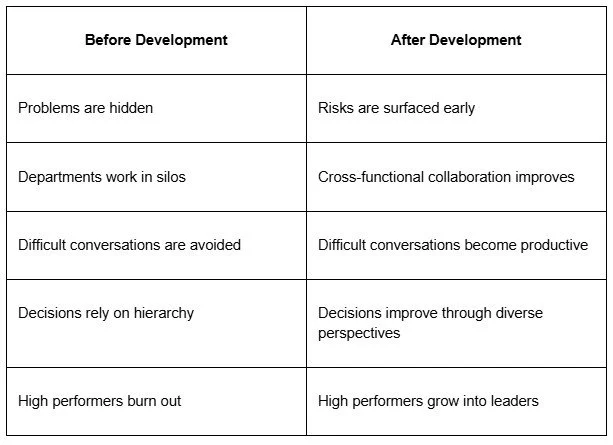
Notice something important.
None of these outcomes require changing organizational strategy.
They require changing how people communicate.
Five Questions Every Leader Should Ask
Before labelling someone as “difficult,” consider these questions:
Are they raising concerns because they care about the outcome?
Have they been taught how to communicate strategically?
Have leaders created psychological safety for honest dialogue?
Are different stakeholder priorities fully understood?
Are we solving the communication problem—or suppressing it?
The answers often reveal that the challenge is cultural rather than personal.
Final Thought
Organizations rarely fail because people identified too many risks.
They fail because the right concerns were ignored until they became crises.
The organizations that consistently outperform their competitors are not those with fewer problems.
They are the ones that create cultures where people communicate strategically, influence respectfully, challenge constructively, and lead with emotional intelligence.
When these capabilities become part of everyday leadership, high performers are no longer seen as problems to manage.
They become the competitive advantage.
Continue the Conversation
If your organization is experiencing challenges such as:
High performers becoming disengaged or leaving
Managers struggling with difficult conversations
Poor cross-functional collaboration
Communication breakdowns between teams
Employees hesitating to speak up despite seeing potential risks
these are often symptoms of skill gaps rather than attitude problems.
Our Strategic Communication, Stakeholder Management, and Emotional Intelligence development programmes equip leaders and professionals with practical tools to influence effectively, navigate complex stakeholder relationships, and build cultures where constructive challenge strengthens—not weakens—business performance.
Ready to develop a culture where high performers thrive instead of burn out? Let’s explore how a tailored learning solution can help your organization build stronger leaders, better decisions, and sustainable performance.